Josh Rombot
Head of Operations
Syntropic Medical GmbH
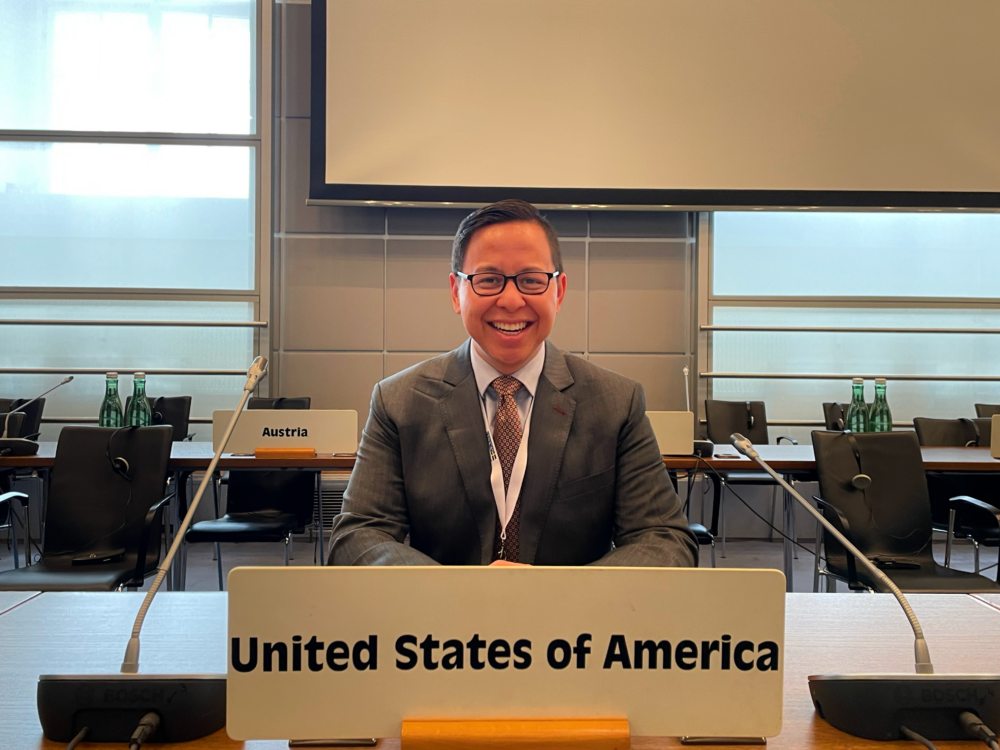
What does the USA mean for you personally?
My parents are first-generation immigrants and integrated into the U.S. while keeping their language, food, and way of being. To me, that’s the best version of the U.S. Growing up in a multicultural household taught me that identity isn’t either-or and one can hold multiple truths at once. That’s a lesson I carry as an American living abroad.
What does the USA mean for your company?
The U.S. represents our most important market opportunity and proving ground. It has the infrastructure, capital, and regulatory pathways to evaluate novel medical technologies, and we’re working toward FDA De Novo clearance as our long-term milestone.
How important are the relations between Austria and the USA?
Programs like the Marshall Plan and Fulbright didn’t just move money or students across borders. They built the assumption that the other side was worth understanding. That assumption is the foundation everything else rests on. Having worked at the U.S. Embassy in Vienna and now leading operations at an Austrian startup, I’ve seen firsthand how deep and durable that foundation is when both sides invest in it.
How can the relations between the two countries be improved and intensified?
More conversations that go deeper rather than point-scoring about which country does something better. We need genuine curiosity about why we each do things the way we do: the history, the context, and the values beneath the surface. Conferences and exchanges are good, but the more impactful work happens in smaller settings among people who’ve decided to take each other seriously. That’s where quality connections actually get built.
How can you/your company benefit more from bilateral trade?
Clearer and faster growth pathways for startups and SMEs. Smaller companies (who often carry the most interesting innovations) need streamlined regulatory coordination, access to pilot programs, and warm introductions that don’t require already knowing the right person. The upside of getting these right is consequential for businesses like ours.
What can Austria do better?
Move faster on the things holding it back from being a serious contender in global commerce. Austria has extraordinary talent, world-class quality of life, and genuine scientific depth. However, the startup and SME ecosystem still carries real friction with complex hiring rules for international talent and regulations that haven’t kept pace with global competition. Austria doesn’t need to become something it isn’t. It just needs to trust its own strengths enough to compete globally.
What can the USA do better?
Reconnect with the long game. The U.S. is exceptional at building things fast, but less good at maintaining them. Things such as infrastructure, institutions, and public trust all require patience and stewardship, not just disruption. Living in Austria has shown me that slowing down isn’t the same as falling behind. There’s a reason „Schau ma mal“ is a cultural philosophy here and not just a phrase. Sometimes being present matters more than being precise.
What can we learn from each other?
Austria can learn to view non-linear career paths as assets. Someone who has worked across sectors, countries, and disciplines is not unfocused. Rather, they demonstrate adaptability, which is an advantage in business and in life.
The U.S. can learn that not everything „worth having“ can be measured. Some of the best things Austria has built (e.g., civic infrastructure, work-life culture, genuine community) resist the logic of optimization, and are stronger for it.
Neither country has the whole answer. That’s exactly why space for these kinds of conversations is worth sustaining.
What has been the best AmCham experience so far?
The countless moments of genuine exchange. A North Carolinian who leaves after visiting Austria with a different impression than they arrived with, or a European counterpart who sees the U.S. differently after a conversation over coffee. Organizations like AmCham create the conditions for those moments.
What do you expect from AmCham?
A bigger platform for members who are still building. I’d love to see more emphasis on smaller members by having their voices influence direction alongside the larger, established members. The collective voice is stronger when it represents the full range of members.